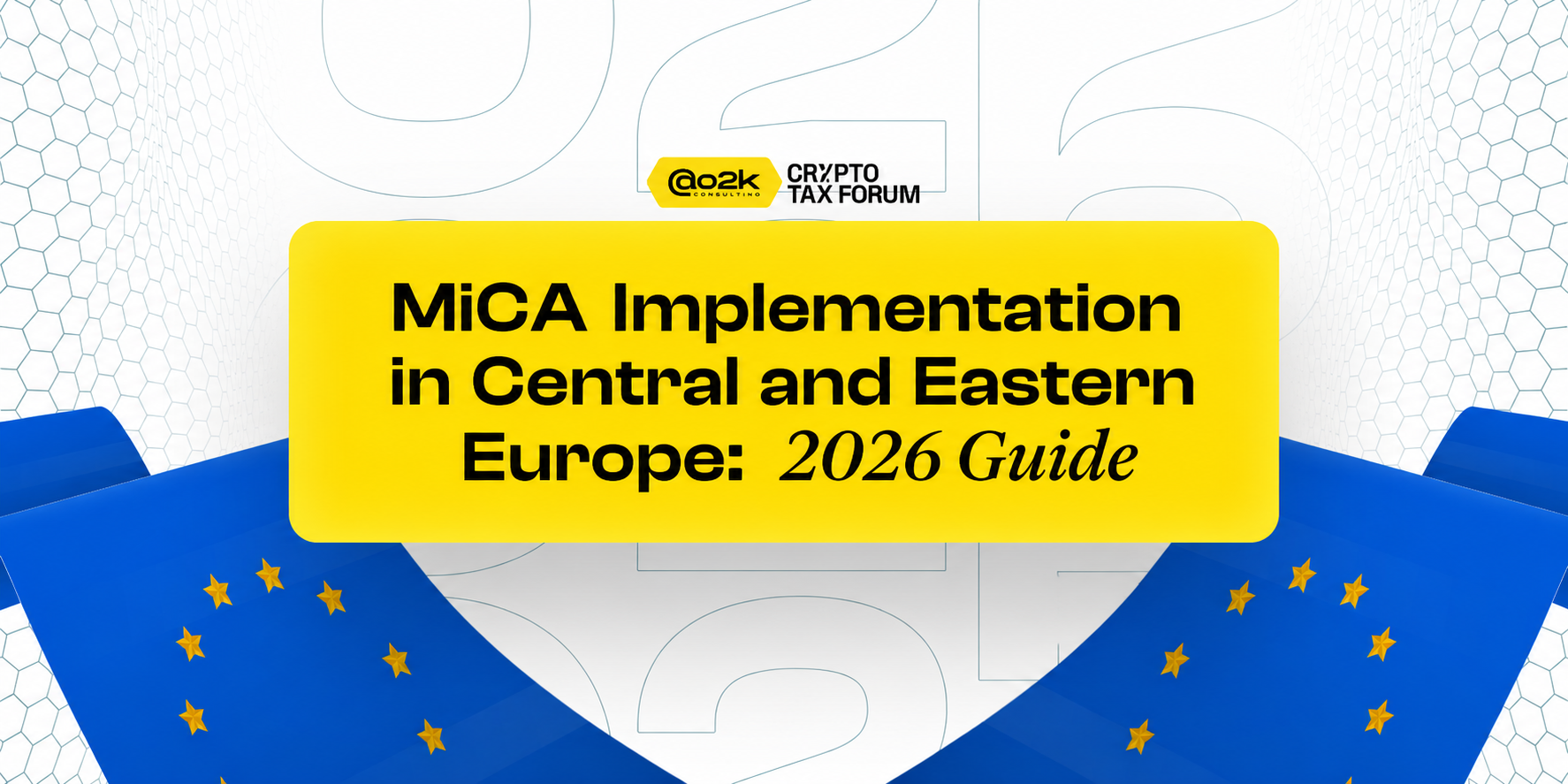
The European Union’s Markets in Crypto-Assets Regulation (MiCA) has now come fully into force, creating the EU’s first harmonised framework for crypto-asset service providers. While MiCA applies directly across all Member States, each country still needs to establish its own supervisory structures, application procedures, and local implementation rules.
Central and Eastern Europe (CEE) has emerged as one of the most active regions in this transition. Countries are moving at different speeds to align national law with MiCA’s requirements, and while the goal is the same which is to ensure clear licensing standards for crypto businesses, the approaches vary.
In this blog, we take a closer look at how Slovakia, Poland, the Czech Republic, Hungary and Slovenia are implementing MiCA.
SLOVAKIA:
Slovakia is undergoing a major shift as it fully adopts MiCA. Since 30 December 2024, crypto businesses operating in Slovakia have been required to meet new licensing and compliance standards. For companies already active in the country or planning to enter the EU market the change brings both challenges and significant opportunities.
Until now, Slovakia had a relatively light-touch regime for virtual asset businesses. For many firms, registering with the Trade Licensing Office was enough to operate but that era is over.
Under MiCA, any company offering crypto-asset services must obtain a CASP licence from the National Bank of Slovakia (NBS).
Thanks to EU passporting, a CASP authorised in Slovakia can operate across all 27 EU Member States without needing additional national licences. This turns Slovakia into a potential gateway for firms looking to scale across Europe.
Transition Period
While MiCA allows Member States an 18-month transitional period, the NBS set a shorter 12-month window. Existing VASPs can operate only until 30 December 2025, unless they obtain their CASP licence earlier.
This accelerated timeline means firms must move quickly to stay compliant.
How to Obtain a CASP Licence in Slovakia
Getting authorised is not a simple formality. Firms must demonstrate solid governance, financial stability, and strong compliance systems.
Key steps include:
● Create a Slovak legal entity: Most firms choose an s.r.o. (limited liability company) minimum capital €5,000.
● Appoint qualified management: At least one director must come from an EU or OECD country and must demonstrate relevant experience.
● Designate a responsible person: A compliance officer must oversee AML/KYC and ensure regulatory reporting.
● Prepare extensive documentation: This includes a business plan, governance structure, risk controls, IT descriptions, and financial forecasts all submitted in Slovak.
● Meet minimum capital requirements:
Based on the service usually €50,000–€150,000.
● Submit to the NBS: The authorisation review typically takes 3 to 5 months depending on complexity and completeness.
For firms used to Slovakia’s previous light requirements, this represents a major operational upgrade. For new entrants, it’s an opportunity to set up with a robust, investment-ready structure from day one.
Obtaining the licence is only the first milestone, MiCA requires continuous, bank-level compliance.
Firms must maintain:
● Strong AML/KYC procedures including customer due diligence and transaction monitoring.
● Clear governance frameworks which includes defined roles, reporting lines, and internal controls.
● Business continuity and security plans to ensure operational resilience.
● Segregation of client assets to protect users in case of insolvency.
● Adequate own funds to support operational risks.
● For token issuers, transparent, MiCA-compliant whitepapers.
Regular reporting to the NBS and ongoing risk assessments will now be a standard part of operations.
POLAND
In Poland, The Polish Financial Supervision Authority (KNF) is responsible for issuing CASP licences, following a structured application process.
Applicants receive an acknowledgment within five days, and the KNF then conducts an initial review within twenty-five working days. If documentation is incomplete, firms must provide missing materials within an agreed timeline.
The full assessment takes another twenty days before the KNF issues its decision. Applicants must provide documentations meeting Article 68 MiCA requirements which includes:
- Operational plans
- Governance and internal-control structures
- IT and cybersecurity documentation
- Risk-management systems
- Capital ranging from €50,000 to €150,000, depending on the service
Overall, Poland mirrors the licensing frameworks seen in many other EU countries, emphasising early preparation to avoid compliance bottlenecks.
CZECH REPUBLIC:
In contrast, the Czech Republic has undergone one of the most significant regulatory transformations in the region.
The Digital Finance Act (Act No. 31/2025 Sb.), effective February 15, 2025, fully incorporates MiCA into Czech law. This marks the end of the lighter Virtual Asset Service Provider (VASP) regime and its replacement with the much stricter CASP licensing system.
The Czech National Bank (CNB) now oversees licensing, enforcement, and broader supervision.
CASPs face extensive capital requirements. From €50,000 for basic advisory services to up to €8 million for high-risk operations such as trading platforms or custodial services and must meet enhanced governance standards. Senior management undergoes fit-and-proper checks, IT and cybersecurity systems must comply with MiCA-aligned technical rules, and client assets must be segregated.
Governance & technical requirements
CASPs must demonstrate:
- Fit-and-proper senior management
- Robust IT and cybersecurity systems
- Segregation of client assets
- Detailed risk frameworks
- Comprehensive conflict-of-interest procedures
Transitional deadlines
- Apply by 31 July 2025 to continue operating
- Must obtain full authorisation by 1 July 2026
- Transitional regime lasts 18 months
It is also important to note that services involving e-money tokens (EMTs) fall under both MiCA and PSD2 (EU Payments Directive). This means some firms will require double authorisation, depending on the business model.
No doubt, the Czech Republic has built one of the most rigorous and technically demanding MiCA frameworks, ideal for institutional-grade firms, but challenging for smaller startups.
HUNGARY
Hungary stands out for taking one of the strictest regulatory stances in Europe.
Through the Crypto Asset Market Act (Act VII of 2024), MiCA was transposed into Hungarian law, and full supervisory responsibility shifted to the Magyar Nemzeti Bank (MNB) on January 1, 2025.
Demonstrating strong AML compliance, all CASPs must obtain authorisation. This includes:
- Exchanges
- Brokers
- Custodians
- ART & EMT issuers
- Crypto-payment and exchange services
The Validator System
Hungary goes beyond MiCA with a unique national layer known as the Validator system.
From 1 July 2025, every crypto-asset exchange transaction must be validated by a state-supervised Validator.
Validators verify:
- User identity & wallet ownership
- Origins of funds
- Transaction risk profile
- Device metadata
- External AML databases
If a transaction does not receive a validation certificate, it is legally invalid.
Criminal Liability Rule
Hungary has also criminalised unauthorised crypto-asset exchange activities. Offences apply to both providers and users for transactions above HUF 5 million (€13,000), with penalties reaching up to eight years imprisonment for service providers.
Complicating matters, the enforcement rules became active before the Validator licensing framework was fully established, creating temporary uncertainty as businesses await the official decree outlining technical standards.
Timeline
The country’s compliance timeline is strict. All CASPs must have MiCA authorisation by July 1, 2025, and anonymous Bitcoin ATM transactions are banned EU-wide from September 2025.
Despite its strict stance, Hungary offers one of the most attractive tax regimes in the EU with 15% personal income tax on crypto gains and 9% corporate tax. This makes Hungary a potentially appealing jurisdiction for fully compliant operators.
SLOVENIA
Slovenia has taken a structured and proactive approach to implementing MiCA. Through the Law on the Implementation of the EU Regulation on Crypto-Asset Markets (ZIUTK), which was effective from November 23, 2024, the country formally aligned its legal framework with the EU regulation.
Licensing Requirements
Crypto firms offering services such as exchanges, custody, brokerage, payments, or token issuance must obtain a Crypto-Asset Service Provider (CASP) licence.
Slovenia splits supervisory authority to ensure specialised oversight. The Securities Market Agency (ATVP) supervises traditional crypto-asset service providers, while the Bank of Slovenia (BS) oversees issuers and service providers of e-money tokens (EMTs) and asset-referenced tokens (ARTs).
Compliance Timeline
Existing Virtual Asset Service Providers (VASPs) must upgrade to CASP licences by July 1, 2026, or they will be required to cease operations. This aligns with the EU’s transitional provisions, giving firms time to adapt while maintaining market integrity.
Beyond core MiCA requirements, Slovenian firms must comply with strict AML standards, customer due diligence, and investor-protection measures. They are expected to prepare comprehensive governance, operational, and risk-management documentation, ensuring transparency and operational resilience.
Taxation
Slovenia also plans to introduce a 25% flat tax on crypto capital gains, effective January 1, 2026, adding another layer of regulatory consideration for crypto businesses operating in the country.
In all, Slovenia’s MiCA implementation provides a clear, predictable, and structured framework, helping crypto businesses operate safely while ensuring investor protection. Firms need to stay updated on both domestic regulations and EU-level developments to remain compliant and competitive.
CONCLUSION
Central and Eastern Europe is becoming a key region for crypto under MiCA. Countries like Slovakia, Poland, the Czech Republic, Hungary and Slovenia are moving at different speeds, but all are setting clear rules for licensing, investor protection, and operations.
Some countries make it easier to get a licence, while others add extra compliance requirements. For crypto businesses, this means acting early to secure licences, follow AML rules, and strengthen operations.
In all, MiCA gives businesses a clear framework and the chance to expand across Europe, build trust with investors, and stay ahead in the emerging markets.
.svg)



.jpg)

.jpg)

.jpg)

.png)
.jpg)
.jpg)

.jpg)

.jpg)
.png)
.jpg)
.JPEG)
%20(1).jpg)
.png)


.jpg)

.jpg)
.jpg)

.png)

.png)




.png)










.jpeg)








.jpg)