
- Bitcoin is trading 50% below its October 2025 all-time high of $126,000
- This is not 2018 — the structural conditions that caused an 84% crash no longer exist;
- The 2026 downturn is expected to be a "Lazy Bear" — a slow, grinding decline driven by behavioural fatigue and macro liquidity conditions, not ecosystem collapse
- Most analysts project a bottom in the $45,000–$50,000 range around Q3 2026
- The right response is dollar-cost averaging through the dip, not waiting for a bottom that won't announce itself clearly
A Word From the Author
I have practiced as a corporate and tax lawyer for 18 years. Roughly one-third of that career has been dedicated to crypto assets. I was among the first in my profession to enter that space and I did so without hesitation, even when colleagues warned me that my reputation was at risk. I was told that crypto was the preserve of criminals. I was told it would never be taken seriously.
Six years later, the industry I believed in is not only legitimate, it is mainstream. And the same voices that once dismissed it are now eager to be part of it. In all that time, I never once made a market prediction or recommended a specific crypto asset to buy, despite being asked almost every day.
This article marks a change in that position. The patterns I have spent years studying are now clear enough that I am prepared to share my conclusions. Everything that follows is a theory. It is speculative by nature. This is not financial advice. But it is the most informed perspective I can offer and I believe it is worth your time.
A Market at Crossroads
The world is finally taking Bitcoin and crypto assets seriously. Countries like El Salvador and the Central African Republic have adopted Bitcoin as legal tender. Jurisdictions such as Germany and Switzerland recognise it as a unit of account and permit its use in legal transactions. Regulations have proliferated across Europe, America, and Asia all of it evidence that mainstream adoption is accelerating.
Given this momentum, one might expect Bitcoin's price to be skyrocketing. Instead, it is currently trading 50% below its most recent all-time high. But why?
The fear-greed index which is a widely used metric for gauging overall crypto market sentiment is deep in extreme fear territory.
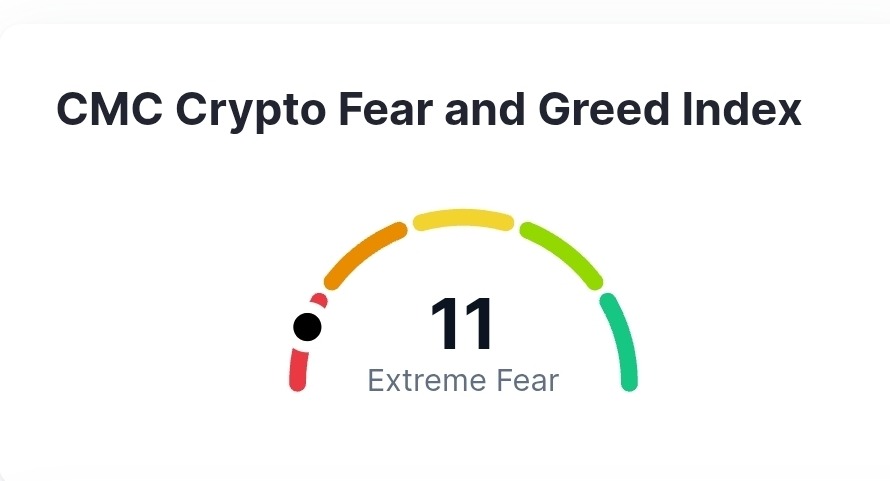
Investors are hesitant to enter the market, afraid that prices will fall further before any recovery begins. This brings us to the question that everyone in the space is asking: Where is Bitcoin's price headed next?
To answer that accurately, we need to understand not just where the market is today, but how we got here and whether this moment resembles the past as much as many fear.
What the 2018 Crash Can Tell Us
Many fear that the current bear market could repeat Bitcoin’s severe 2018 crash. To assess that risk, we first need to see why 2018 was so extreme. The 2018 bear market was severe because it was built on a foundation of extreme speculation and structural fragility.
In 2017, thousands of Initial Coin Offerings (ICOs) raised billions of dollars with little regulatory oversight, weak fundamentals, and wildly unrealistic promises. When regulators, particularly the U.S. SEC began cracking down, liquidity evaporated and the vast majority of those tokens became worthless.
Bitcoin was not insulated from this. As the reserve asset of the entire ecosystem, when altcoins collapsed, capital fled indiscriminately. The 2017 rally had also been heavily retail-driven, with new investors pouring money in at parabolic prices near $20,000. When the reversal came, panic selling accelerated the decline with brutal efficiency.
From its December 2017 high of approximately $19,783, Bitcoin fell roughly 84%, bottoming near $3,100 in December 2018, the deepest crash in the asset's history at that point.
The severity of that crash was not inevitable. It was a direct consequence of the market's immaturity. There were no institutional investors of significance, no spot Bitcoin ETFs, and almost no macro integration. Bitcoin was still considered a fringe asset by mainstream finance. When confidence broke, there was simply nothing beneath it. No structural bid, no regulated infrastructure, no institutional capital to absorb the selling pressure.
But that was then. The market today is a fundamentally different animal.
Why 2026 Is Unlikely to Repeat 2018
Bitcoin's position in global markets has changed substantially. Today, it is held by institutional investors, integrated into diversified macro portfolios, supported by regulated financial products, and accessible via spot ETFs. It is traded with far greater liquidity across global markets, and leverage is more regulated and transparent than at any prior point in the asset's history.
The 2022 crash, while severe, also illustrated this structural shift. It was driven by specific systemic failures, most notably the collapse of FTX and leverage cascades, rather than the kind of broad speculative unwind that defined 2018. Painful, yes. But categorically different.
As markets mature, volatility tends to compress. Bitcoin and in extension the cryptocurrency industry is maturing rapidly, shaped by the significant wave of regulation that has arrived over the past few years. This does not mean Bitcoin cannot fall sharply. But the conditions that produced an 84% collapse in 2018 no longer exist in the same form.
The evidence is visible in how the market now responds to shocks. To illustrate, following the largest liquidation event of 10 October 2025, Bitcoin dropped from $126,000 to near $100,000 and recovered to approximately $114,000 almost immediately. That speed of absorption reflects a market with institutional depth beneath it.
What this suggests is not that the next downturn will be painless but that it may be structurally different from anything we have seen before. Slower and shaped by macro liquidity cycles rather than ecosystem collapse. This is what I am calling the Lazy Bear.
Understanding the Bitcoin Cycle
To understand why a slow bear market is now the more likely outcome, it helps to understand the structural rhythm that has driven every Bitcoin cycle to date. Each cycle has followed a very consistent pattern, as shown in the illustration below.
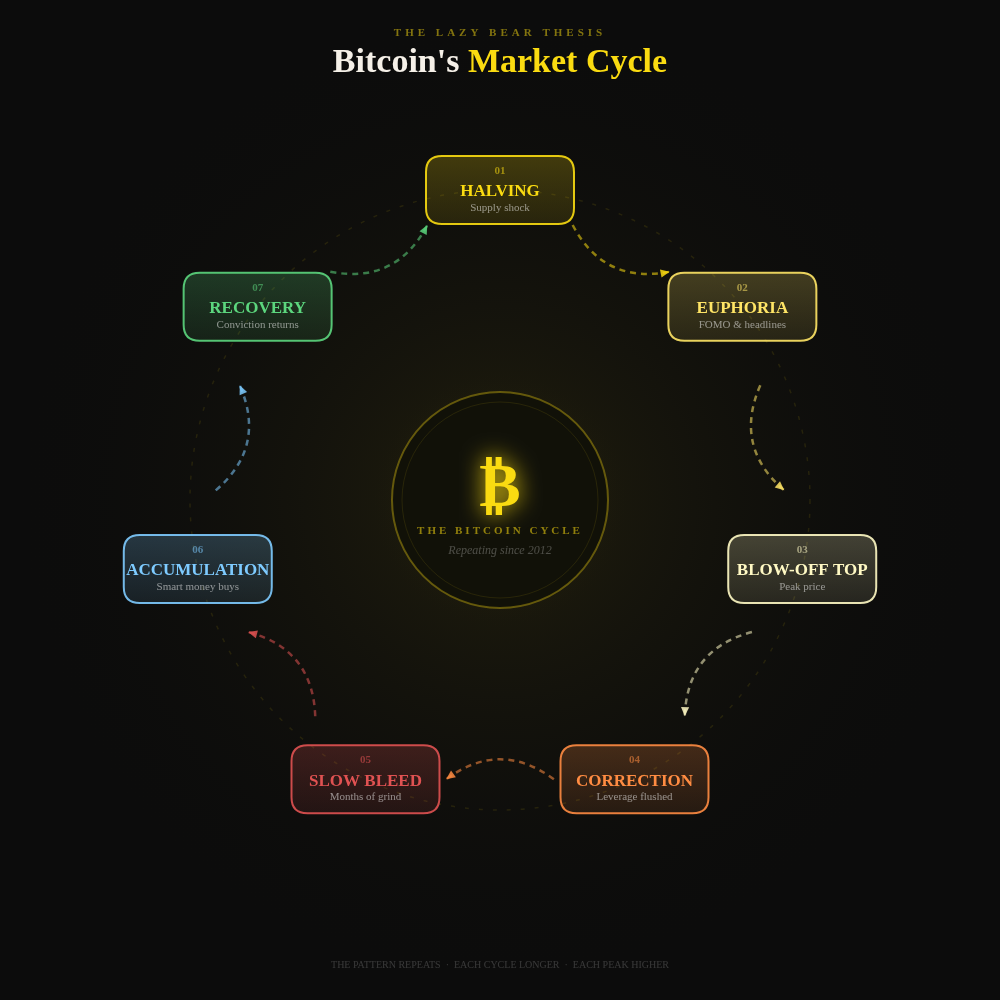
1. The Halving: Where Every Cycle Begins
A Bitcoin halving is an event that occurs roughly every four years in which the reward paid to miners for processing new blocks is cut in half. Bitcoin was designed to become progressively scarcer over time. When it launched in 2009, miners received 50 BTC per block. After each halving, that reward drops by 50%. When the supply of new Bitcoin entering the market slows while demand holds steady or grows, upward price pressure tends to follow.
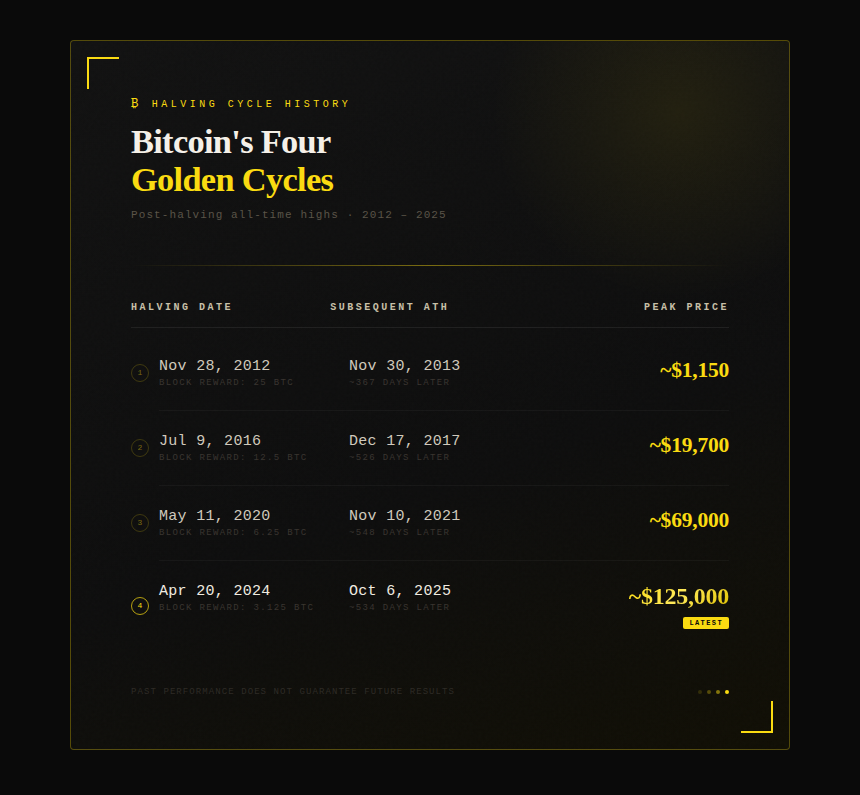
Historically, each halving has preceded a major bull run and a new all-time high within roughly 12–18 months as seen in the image below. Past performance does not guarantee future results. But the structural rhythm has proven remarkably consistent across four consecutive cycles.
2. Euphoria: The Peak Nobody Recognises in the Moment
Following the halving-driven rally, the market enters a euphoria phase characterized by maximum optimism, accelerating narratives, and heavy positioning from all directions.
This is the period when headlines announce governments adopting Bitcoin as legal tender, new friendly regulations, high-profile political figures embrace crypto publicly or launch tokens, and retail investors flood back in, driven by the fear of missing out. It feels, in the moment, as though the rally will never end.

3. Post-Peak Correction and the Weak Bounce Trap
After the blow-off top, the first wave of selling hits. Funding rates reset, open interest collapses, and an initial 25–40% correction plays out. This is the stage many investors mistake for the final bottom. It rarely is.
A relief rally follows enough to generate a "we're back" narrative and a lower high. This stage traps late buyers who interpret the bounce as a resumption of the bull market. It is not. It is the setup for what comes next.
4. The Lazy Phase
In previous cycles, the phase following the weak bounce was often violent. A sharp, rapid capitulation that flushed out remaining holders and cleared the way for recovery. What I am proposing is that this cycle's equivalent phase will look very different. Instead of a panic-driven collapse, the market enters a slow bleed, choppy, directionless price action and the gradual erosion of sentiment over many months.
This is where behavioural fatigue becomes the dominant force. In 2018, panic was immediate and acute as participants were forced out quickly and decisively. But in a slow bear market, hope lingers. Holders continue to hold. Investors keep buying dips, only to watch the dip getting dipper.

The regulatory dimension adds another layer to this fatigue. Frameworks such as DAC8 and the OECD's Common Reporting Framework (CARF) which facilitate automatic exchange of crypto-related financial information between tax authorities have introduced a layer of institutional uncertainty that compounds the psychological weight of a slow-moving market.
5. The Accumulation Base
Following the slow bleed, a prolonged base forms likely within a well-defined price zone, building the foundation for the next halving cycle anticipated in 2028.
Where Is Bitcoin Now — and Where Is It Going?
At the time of writing, Bitcoin is trading at approximately $64,000, having broken support near $80,000 and fallen almost 50% from its October 2025 all-time high.
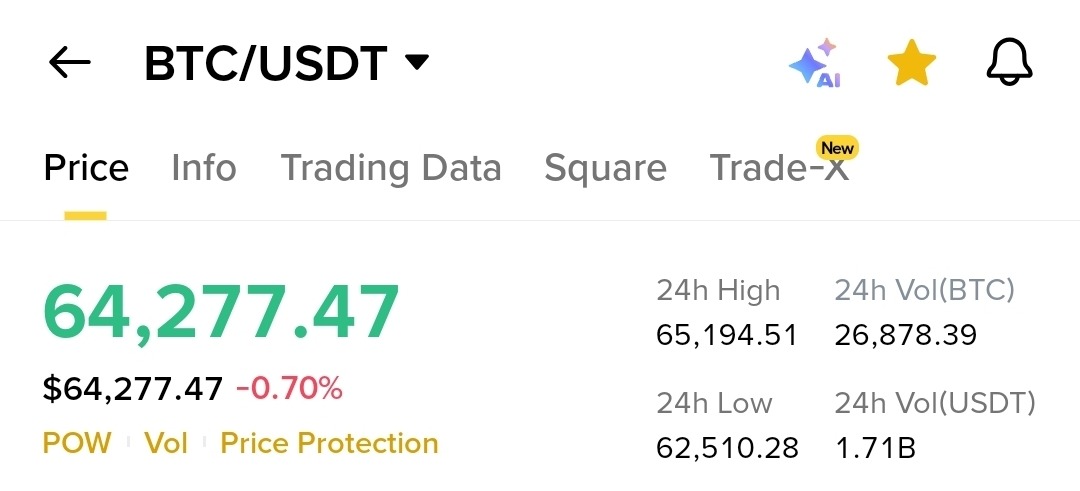
Most quantitative and technical analysts expect further downside, with the majority of projections clustering around a bottom in the $45,000–$50,000 range. That would represent a 65% decline from the all-time high. Significant, but far from the 84% collapse of 2018.
A tweet from May 2025 resurfaced on X in February 2026 in which a technical analyst applied Elliott Wave Theory to predict precisely this outcome, a Bitcoin bottom at $50,000. The post garnered over 12 million impressions, largely because its prior analysis had been accurate. Several other analysts have independently arrived at similar conclusions.
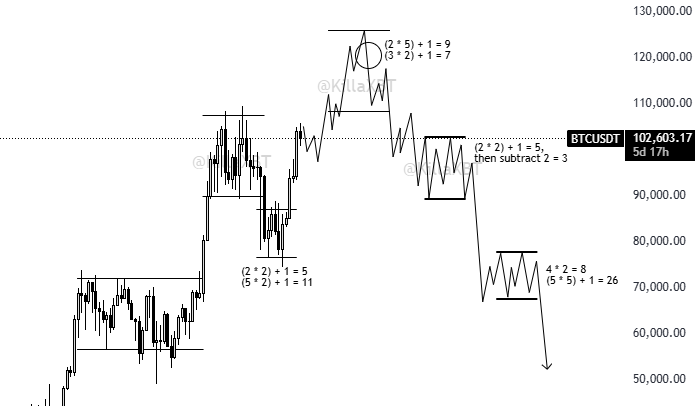
Is this prediction corect? Probably. But the more important point is not the exact figure it is the shape of the move getting there.
My prediction is that Bitcoin will present a meaningful buying opportunity in approximately Q3 2026, with a likely trough in the $45,000–$50,000 range. Not a violent crash, but a slow, grinding descent that will test the conviction of even the most committed long-term holders.
In general, each Bitcoin cycle has delivered lower percentage gains, shorter explosive runs, and shallower crashes than the one before. This is what happens when a speculative asset grows up. It starts behaving less like a lottery ticket and more like a traditional macro asset. That cuts both ways.
The next crash is unlikely to be catastrophic, but the next rally is unlikely to be parabolic either. The gains will come just not overnight, and not without patience.
Conclusion
The most dangerous bear market is not the violent one, it is the one that slowly bores you into giving up.
The next Bitcoin downturn may not arrive with panic. It may arrive with silence, sideways price action, and the quiet temptation to walk away. With regulation tightening globally, that is exactly the kind of market I expect: a lazy bear, defined by fatigue rather than fear.
Nobody knows the exact bottom. Trying to time it perfectly is a losing game. The wiser move is to dollar-cost average (DCA), buying small, consistent amounts of Bitcoin at each price dip rather than waiting for a bottom that may never announce itself clearly.
So keep your portfolio diversified, keep your income stable, and let the market rest. The Lamborghini can wait. Bitcoin has rewarded patience before, and there is no reason to believe this cycle will be any different.

.svg)




.jpg)

.jpg)
.jpg)



.png)
.jpg)
.jpg)

.jpg)

.jpg)
.png)
.jpg)
.JPEG)
%20(1).jpg)

.png)




.jpg)

.jpg)
.jpg)

.png)

.png)







.png)














.jpeg)








.jpg)