.png)
- Taxation can play an important role in supporting the environment for private investment.
- The session surfaced a core tension: tax incentives for innovation are effective, but poorly designed ones add complexity and erode the revenue base.
- SMEs and large multinationals do not benefit equally from existing tax frameworks; the design gap matters as much as the policy intent.
- Europe’s competitiveness challenge cannot be solved by tax policy alone, but the wrong tax environment can actively make it worse.
- Businesses that proactively engage with evolving EU tax incentive frameworks, rather than treating them as compliance afterthoughts, stand to gain a meaningful advantage.
Introduction
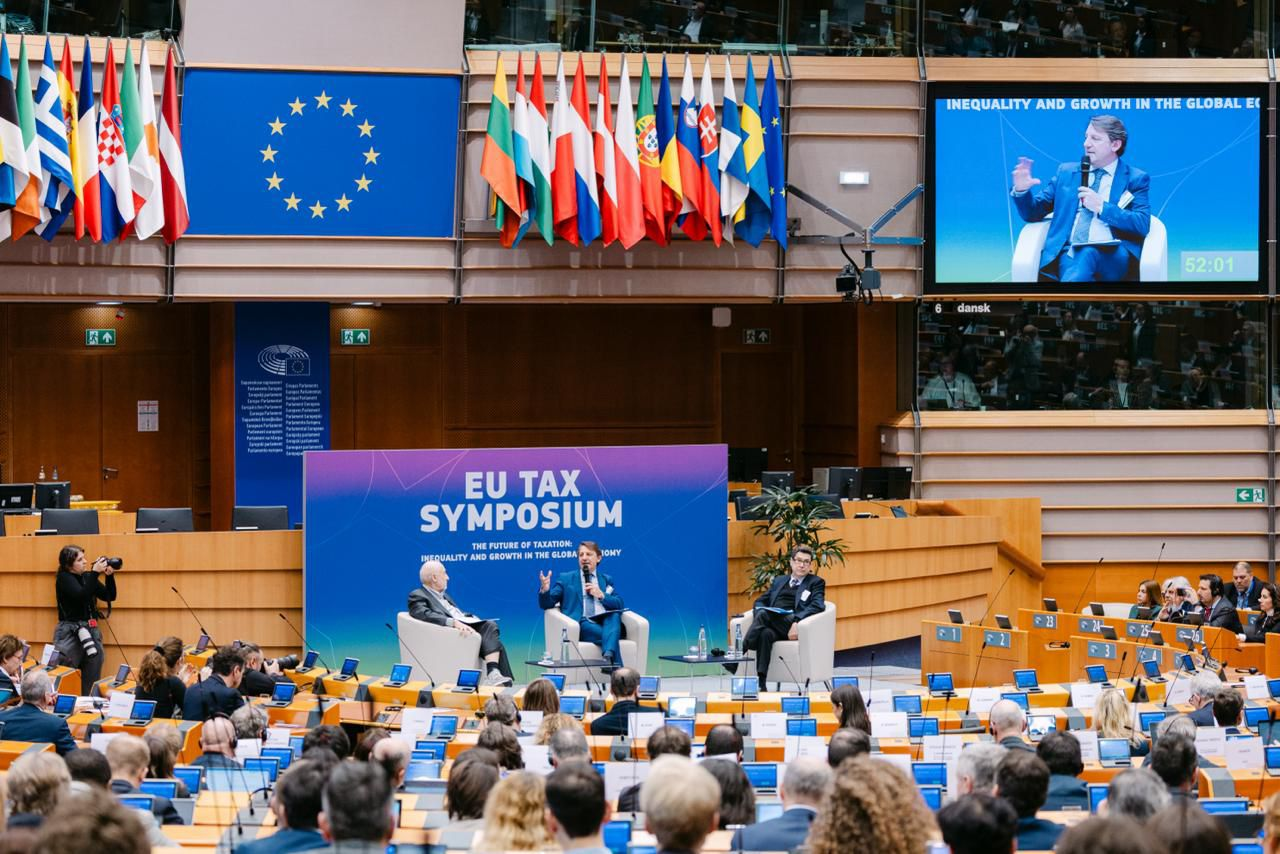
The fourth edition of the EU Tax Symposium took place on 16-17 March 2026 under the headline “The Future of Taxation: Inequality and Growth in the Global Economy,” bringing together representatives of the European and national parliaments, high-level representatives of the Commission and Council of the EU, tax experts, academics, and stakeholders. Day 1 opened the substantive debate with a deliberately practical question: Can tax policy actually drive growth and innovation, and if so, how?
Panel one on how taxation support growth and innovation brought that question into sharp focus.
The Panel Session
The panel featured the following speakers:
- Jussi Saramo MEP, Member of the Subcommittee on Tax Matters
- Jörg Kukies, former Minister of Finance of Germany
- Scott Levine, Partner at Baker McKenzie and former US Treasury Assistant Secretary
- Véronique Willems, Secretary-General of SME United
- Marc Lemaître, Director-General for Research and Innovation at the European Commission, serving as moderator.
The lineup was striking in its breadth: a legislator, a former finance minister with direct policy experience, a transatlantic tax practitioner, and a voice for Europe’s small and medium-sized businesses.
The Central Argument
Taxation can have an important role in supporting the environment for private investment. Well-designed and cost-effective tax measures can stimulate private investment in strategic areas, and a more streamlined and clear tax system can reduce complexity and support growth, which is essential to ensure Europe’s long-term competitiveness.
This framing is significant. It positions tax not merely as a revenue instrument but as an active lever of industrial and innovation policy. The question is whether the EU’s current frameworks are actually calibrated to deliver on that potential.
Where the Debate Gets Difficult
The Panel did not shy away from the harder edges of this argument. Tax incentives for R&D and innovation, credits, patent boxes, and accelerated depreciation are widespread across Member States, but their effectiveness is uneven. Design flaws, eligibility complexity, and fragmentation across national systems mean that larger, better-resourced firms are systematically better positioned to capture these benefits than the SMEs and scale-ups that arguably need them most.
Willems’ presence as the SME United voice brought this asymmetry to the table directly. For smaller businesses, the administrative cost of accessing innovation-linked tax reliefs can approach or exceed the value of the relief itself, a perverse outcome that undermines the policy rationale. Meanwhile, Levine’s transatlantic perspective introduced the competitive dimension: the US Inflation Reduction Act has demonstrated how aggressive, well-structured fiscal incentives can redirect private capital at scale. Europe is not competing in a vacuum.
Kukies, drawing on his experience steering German fiscal policy, added the governance layer: the challenge is not only designing effective incentives but maintaining political commitment to them over the medium term, resisting the pressure to phase out or restrict reliefs when fiscal conditions tighten.
Why This Matters Now
Europe is navigating a convergence of pressures, sluggish productivity growth, rising defence expenditure demands, the green and digital transitions, and competitive headwinds from both the US and China. A more streamlined and clearer tax system that reduces complexity is essential to ensure Europe’s long-term competitiveness. That is not a minor observation. It implies that the current system, fragmented, complex, inconsistent across Member States, is itself a drag on the growth the EU needs.
The Panel also implicitly set the stage for Panel 2 of the same day, which examined simplification and compliance burden reduction: the two are inseparable. An innovation-supportive tax environment that is also administratively burdensome is not, in practice, innovation-supportive.
What Businesses Should to Watch
The Commission’s ongoing work on Business in Europe: Framework for Income Taxation (BEFIT) and the broader simplification agenda will determine whether the ambitions discussed in panel one translate into legislative reality. For multinationals and growing firms, the key questions are:
- How quickly will harmonised or mutually recognised R&D incentive frameworks develop across the EU
- Whether the Commission will move toward a more coordinated approach to innovation-linked tax expenditures
- How the interaction between Pillar Two’s minimum tax and existing R&D credits will be resolved without undermining investment incentives.
The message from this panel was clear: taxation is not a passive backdrop to growth, it is an active variable. Getting it right is an economic imperative, not just a technical exercise. For businesses operating in or expanding into the EU, understanding how the incentive landscape is evolving is no longer optional.
.svg)



.jpg)

.jpg)

.jpg)

.png)
.jpg)
.jpg)

.jpg)

.jpg)
.png)
.jpg)
.JPEG)
%20(1).jpg)



.jpg)

.jpg)

.png)

.png)






.png)











.jpeg)






.jpg)