- The panel on taxation of digital activities provided various opinions on whether Pillar 1 is a workable opinion or if discussions should move towards a new solution.
- Debates arose also on whether the EU should adopt unilateral measures for taxing large multinational companies or if the only correct option is to find a global solution.
- Some argued that the EU has to act fast and adopt its own DST.
- According to the others, DSTs create fragmentation and harm the economy.
Introduction
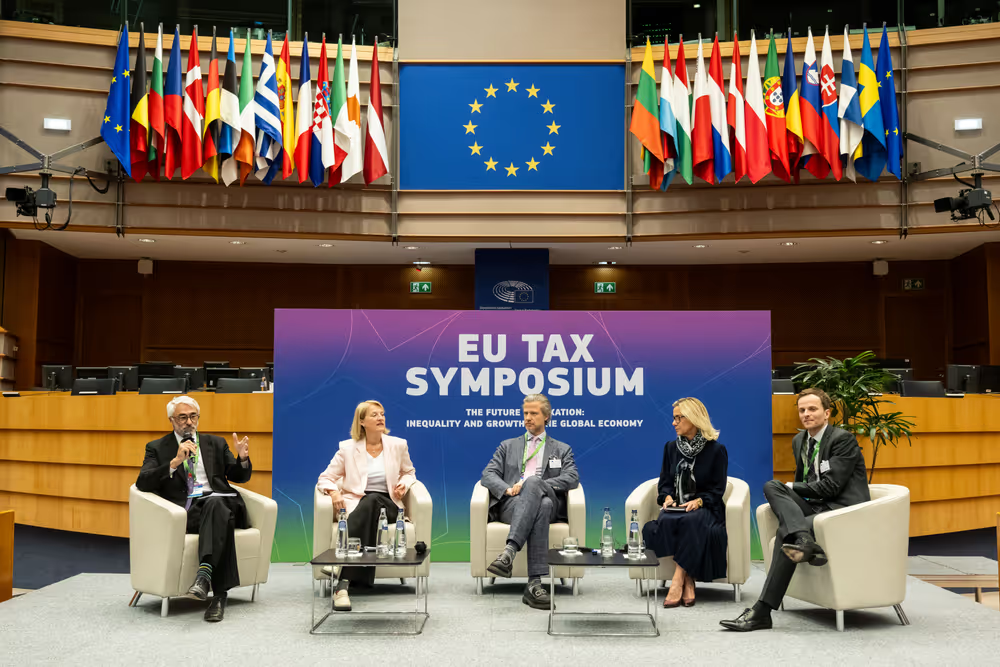
The European Parliament and the European Commission co-organised the fourth edition of the EU Tax Symposium on 16th and 17th of March 2026, themed “The future of taxation: inequality and growth in the global economy”.
The first panel of the second day was titled “The EU at a crossroads between international tax cooperation and strategic autonomy in taxing digital activities”.
Pascal Saint-Amans, a senior fellow at Bruegel, moderated the panel. The four speakers were:
- Evelyn Regner, a member of the European Parliament and a member of the subcommittee on tax matters
- Rebecca Burch, a deputy assistant secretary for international tax affairs at the US Department of the Treasury
- Christian Kaeser, a global head of tax at Siemens
- Christoph Trautvetter, an executive director at Tax Justice Germany.
The focus of the discussion was on the fate of Pillar 1, which is the OECD’s 2019 tax reform project to (1) re-allocate 25% of the largest and highly profitable companies’ residual profits to the countries where their customers are located, meaning that the companies would not only be taxed based on their locations (“Amount A”) and (2) simplify the calculation of taxable profits (“Amount B”).
- The project began already in 2013, when the BEPS project and Action 1, focusing on the digital economy, were launched.
- In 2015, the OECD concluded that there is no separate “digital economy”; rather, the whole economy is becoming digital, finding the issue to be broader than just tech companies.
- As no consensus was reached, many countries, including France, Spain, and the UK, started introducing their own, unilateral digital services taxes (DSTs).
- In 2019, Pillar 1 was proposed, with two major changes: (1) a company can be taxed in a country without physical presence, and (2) part of the company's profits should be reallocated to market countries.
- In 2021, 139 countries agreed on Pillar 1. However, its scope was limited to apply only to very large multinationals, including companies with more than €20 billion revenue and 10% profitability.
- However, this proposal has not yet been signed, and in January 2025, the United States announced its withdrawal from it.
The Existence of a Distinct “Digital Economy”
According to Kaeser, all companies implement digital elements, which is why the differentiation between digital and non-digital economies will not succeed. As an example, he used the automotive sector in which every car uses and generates data. He wanted to fix the misconception that Pillar 1 is about the digital economy; while its scope targets many digital companies, it was not made to only capture these.
Regner focused specifically on digital taxation. She emphasised the need for a digital tax in order to adapt to the changing markets; her view was that failing to tax digital activities means living in a “tax stone age”.
Conversely, Burch, with an American perspective, questioned whether the digital economy can, or should, even be taxed. She expressed concern that attempting to reach a solution too quickly could risk repeating the Pillar One situation, in which the US ultimately did not adopt the proposal. Instead, Burch stressed the importance of constructive dialogue between states.
The Future of Pillar 1
A discussion on the future of the Pillar 1 provided many different viewpoints. The most, so to speak, optimistic opinion was provided by Regner, who thought that although Pillar 1 is on hold, it is the correct instrument to achieve tax policy goals. Hence, she did not necessarily view that Pillar 1 had come to its end but rather supported its continuation.
Kaeser and Trautvetter also saw Pillar 1 theoretically as a good solution, but they agreed that it is not a workable one.
Kaeser said to be a “big fan of Amount A”, but that, realistically, countries would not agree on the new global allocation of profits as it would create winners and losers among them.
Trautvetter emphasised that Pillar 1 should be “declared dead” to move forward. Regardless, he liked its aim and stated that the largest companies should be taxed in order to support competition and equality. According to him, these large multinationals have such a strong hold over the market that other companies are unable to compete against them; hence, taxation should provide a tool to support the smaller companies.
Multilateral Solution vs Unilateral Action
The most controversial and divisive topic of the panel was whether the EU should rely on a potential multilateral solution or start taxing digital activities by itself.
Regner and Trautvetter, while agreeing that the “Plan A” should be a multilateral, global tax, both supported a “Plan B”, an EU-wide DST. They both argued that this is needed in order to protect local economies and smaller companies.
Regner used local cafes as an example: they support the local economy and pay appropriate taxes, while large tech companies can shift profits and avoid taxes, resulting in smaller companies bearing the tax burden.
Trautvetter noted that he does not necessarily like digital service taxes but that they, regardless, solve the problem “by accident” as they target the same companies as tax instruments focusing on major enterprises would. He emphasised that the solution must be found swiftly, as large companies are growing constantly and competition against them becomes more difficult every day. According to him, a DST is the only solution that could be passed quickly enough.
Kaeser, on the other hand, looked at the argument from the business standpoint and strongly opposed the unilateral digital taxes. From his view, fragmented taxes would result in a situation where companies have to comply with many different national rules, ultimately leading to high compliance costs. Therefore, he concluded that the correct forum to decide on these taxes is the OECD, not the EU.
Burch, like Kaeser, opposed the DSTs, explained that the US sees DSTs as a problem for trade, and preferred to find a global consensus. She continued to emphasise the importance of dialogue, which would also have to take into account the changes, such as Pillar 2, that have not been considered before. Lastly, she noted that if countries start acting alone, this will kill the conversation among them.
The Emphasis on Competitiveness
Lastly, the discussion moved to competition, where Kaeser and Trautvetter came up with two opposing stances.
According to Kaeser, DSTs would lead to inflation as well as high compliance costs, which would harm competition and be particularly damaging for the already struggling industries. He also argued that if the taxation in the EU targets large American companies, this will lead to the US potentially responding with its own countermeasures and harm the European economy as a whole.
In Trautvetter’s opinion, taxing large companies in the EU is good for competition as it makes them less advantaged and would, thus, create room for smaller companies.
Conclusion
It can be concluded that there exists no common ground on how to proceed with the digital tax debate. This is not limited only to Pillar 1, but the issue is broader: whether the EU should keep prioritising international cooperation or move toward its own autonomous tax measures.
While all four panellists agreed that a common, multilateral tax would be the ideal solution, one side argued that unilateral taxes would damage economies, harm companies and put a full stop to the dialogue between states, whereas the other claimed that continued delay would only strengthen large multinational corporations to a point where governments may no longer be able to effectively regulate them.
Although Pillar 1 has not officially been cancelled yet, it is not a functioning solution anymore. Therefore, the EU has to make a choice on whether to keep hoping for a multilateral agreement or start creating its own solution, thus developing in a different phase than countries outside of the EU. It is, however, clear from the panel discussion that both sides entail risks, and there is no agreement on which option is the better one.
*You can watch the whole Panel through this link [Day 2 - European Parliament, time: 1:09:30-2:06:00].
.svg)



.jpg)

.jpg)

.jpg)

.png)
.jpg)
.jpg)

.jpg)

.jpg)
.png)
.jpg)
.JPEG)
%20(1).jpg)

.png)


.jpg)

.jpg)
.jpg)

.png)







.png)












.jpeg)






.jpg)