- The side-by-side agreement of G7/G20 marks a turning point from Pillar Two's initial vision
- Currently only the US is formally recognised as an equivalent regime as of January 2026
- The risk of double taxation is minimized but the compliance burden remains high between two parallel tax systems
- The minimum tax of 15% is now a reality and tax haven approach of multinationals has become difficult
- Multinationals who understand their exposure will be in a better position than those who lag behind
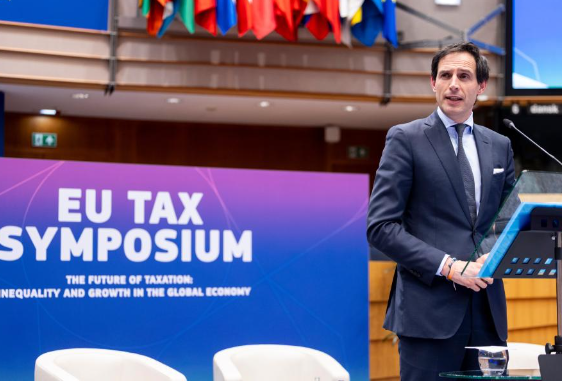
At the 2026 EU Tax Symposium, the panel titled "From Pillar Two to a side-by-side approach" featured Tim Power (OECD/UK), Raluca Enache (Head of EU Tax at KPMG), and Zorka Milin (FACT Coalition). The discussion made it clear that the global tax landscape has changed significantly. Tax departments and international investors have long prepared for a unified global minimum tax framework.
However, the introduction of the side-by-side tax agreement has changed the playing field. By accepting major economies such as the US to cooperate with Pillar Two through "equivalent" tax regimes, the 2026 deal opens an important new path for minimizing the risk of double taxation.
This post simplifies the latest insights from the 2026 OECD tax symposium to help you stay ahead of these rapidly changing global tax rules.
Why Pillar Two Was Introduced: BEPS and Profit Shifting
The agreement was needed because large multinational companies used to shift their profits to zero or to low-tax countries. This leads directly to countries losing billions in tax revenue. In response, OECD and G20 made a decision to launch the BEPS project (Base Erosion and Profit Shifting). This is a coordinated international effort to prevent companies artificially shifting profits away from where they actually do business.
Therefore, the so-called Pillar two was introduced, which is a global 15% minimum tax agreement signed by 130+ countries around 2021. The tax is intended as a top-up in the cases where companies pay less than 15% in any given jurisdiction. If a company pays less than 15% another country (typically where the parent company headquarter is) can charge the difference.
What is the Pillar Two "Side-by-Side" Regime?
The Pillar Two was made with the assumption that everyone would adopt the same unified rules. However, this did not exactly happen, for example, the US directly resisted adopting the Pillar Two rules. This was a significant setback from the start, as the largest multinationals predominantly come from the US.
Nevertheless, a compromise was found where countries can use their own "equivalent" national rules that sit alongside Pillar Two instead of inside of it. As long as the final outcome is roughly the same (15% minimum) the national measures can differ. In January 2026 the OECD officially listed the US as the only "Qualified Side-by-Side Regime" meaning that the US multinationals are now exempt from Pillar Two top up taxes in countries outside the US.
This represents a key development in international tax cooperation opens the door for the US to participate without fully being inside the OECD rules. Think of it this way: The same destination, different roads. This development reduces the risk of double taxation where the same profits are taxed twice by two different countries.
The G7/G20 Deal: What Was Actually Agreed on Equivalent Tax Regimes
The G7/G20 officially endorsed the "Qualified Side-by-Side Regime" as a considerable step forward. The Tax Symposium described this as a further significant milestone in the international tax collaboration. The package centres on three core commitments: the formal acceptance of equivalent national regimes, a framework governing how the two systems interact without creating conflicting obligations, and a shared baseline for tax transparency standards.
This was also brought up during the 2026 Symposium by Tim Power (OECD/UK) who stressed how aligning large economies is significant and an achievement, even if it is done imperfectly. The next priority is the implementation. However, this remains a political compromise, far from the original solution proposed.
Pillar Two Compliance in 2026: What Multinationals Must Do Now
Multinationals are now required to audit which rules apply to them in various jurisdictions. Equivalent domestic regimes or Pillar Two directly? Risk of double taxation is reduced but it is not at zero, interaction between these systems still results in grey areas. As highlighted by Raluca Enache (Head of EU tax at KPMG), compliance costs are expected to remain high as businesses are required to invest in tax specialist departments. After all, now companies are required to understand two parallel systems. For these reasons, Raluca also urgerswift simplification of the Pillar Two and equivalent tax regimes.
Nevertheless, the 15% tax floor is now becoming concrete and tax haven strategies are expected to decrease notably for multinationals. In the case for smaller and medium-sized companies compliance complexity and costs may feel the most acute. A practical tip is to review the benchmark of the 15% tax against your group's effective tax rate before regulators do it for you.
The Road Ahead
Currently, the implementation is uneven. Certain countries have passed domestic laws and other countries have not. Zorka Milin (FACT Coalition) points out that the compromise of "equivalent" regimes might erode the original ambition, and questions if this can truly deliver the same results.
One obvious question mark is the geopolitical tensions (especially US-EU) that will frame how this will evolve. What is expected is that the OECD will continue to work on administrative guidance and minimize friction between the systems. The equivalent tax regimes might be a temporary bridge or it may become a fixed reality. Most observers agree that the deal is an important step forward. Whether it can fulfill the initial goal is an open question. Therefore, @O2K will be watching for further G20 and OECD guidance updates and whether other countries will be formally recognised as equivalent tax regimes under Pillar Two.
Conclusion
The world has moved forward from a clear-cut dream of global minimum tax to a compromise that can be considered a real political win. The side-by-side or equivalent tax regime is certainly progress, but the business cannot afford to wait for a perfect clarity. Is your company ready for a new global tax reality?
Our mission is to help you understand these issues and to stay ahead as OECD guidance develops. Whether you are assessing your Pillar Two obligations, mapping your exposure under the new side-by-side framework, or planning your cross-border tax structure for 2026 and beyond, that is exactly what we help with at @O2K. Get in touch or book a consultation, we can take it from there.
.svg)



.jpg)

.jpg)
.jpg)

.png)
.jpg)
.jpg)

.jpg)

.jpg)
.png)
.jpg)
.JPEG)
%20(1).jpg)
.png)


.jpg)

.jpg)
.jpg)

.png)



.png)










.jpeg)






.jpg)