- All crypto businesses operating in the Balkans must obtain a MiCA licence by 1 July 2026 to continue serving customers legally.
- Bulgaria and Croatia have fully implemented MiCA and have already started issuing CASP licences.
- Greece has one of the region's most mature frameworks and is actively supervising crypto firms under MiCA.
- Slovenia is approaching the end of its transition period with a functioning licensing regime and a new 25% crypto capital gains tax.
- Romania remains the only country in the group without a complete MiCA authorisation framework, creating uncertainty for local crypto businesses.
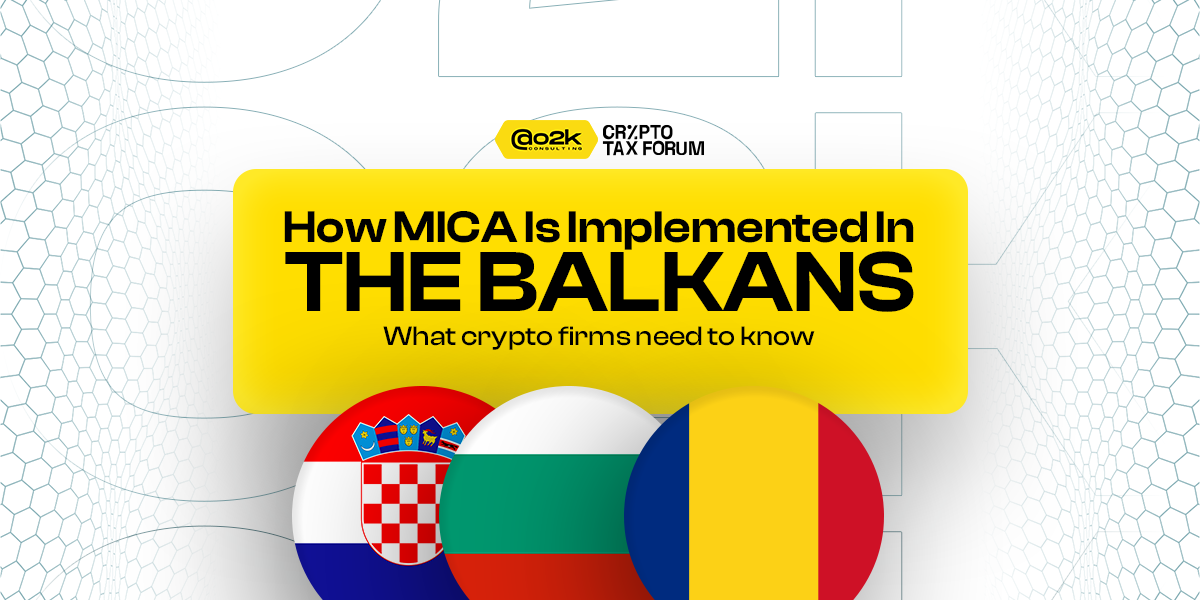
The Balkans are entering the final stage of MiCA implementation. With the EU-wide transition period ending on 1 July 2026, crypto-asset service providers (CASPs) across Bulgaria, Croatia, Romania, Slovenia, and Greece must ensure they are properly authorised to continue operating.
While MiCA establishes a single regulatory framework for crypto businesses across the European Union, implementation has progressed at different speeds.
At the same time, countries across the region are introducing DAC8 reporting requirements, expanding transparency obligations for crypto transactions and bringing national reporting standards closer in line with the OECD's Crypto-Asset Reporting Framework (CARF). Together, MiCA and DAC8 are reshaping how crypto businesses operate, report, and expand within the European market.
Despite these shared EU requirements, the regulatory experience differs significantly from one jurisdiction to another. Licensing procedures, supervisory approaches, implementation timelines, and enforcement readiness vary across the region. Understanding these differences is becoming increasingly important as the transition deadline approaches.
Below, we examine how Bulgaria, Croatia, Romania, Greece, and Slovenia have implemented MiCA, where each country stands today, and what crypto businesses should know before seeking authorisation.
Bulgaria:
Bulgaria has moved beyond legislative implementation and into active licensing. The country's MiCA framework has been in force since July 2025 through the Markets in Crypto-Assets Act, with the Financial Supervision Commission (FSC) serving as the competent authority for licensing and supervision.
The FSC has already demonstrated that authorisation standards will be rigorously enforced. Several applications have reportedly been rejected due to incomplete documentation and compliance deficiencies, highlighting the regulator's strict approach. In April 2026, Bulgaria issued its first MiCA licence, marking an important milestone in the country's transition from theory to practice.
For applicants, capital requirements follow MiCA's standard structure, ranging from €50,000 to €150,000 depending on the services provided. CASPs must also maintain sufficient financial reserves to cover operational expenses and demonstrate robust governance, risk management, and compliance procedures.
Providers who have not yet obtained a license will have to face the administrative penalties such as the following:
- FSC enforcement action
- Fines on the company and its officers
- Criminal liability for repeated breaches
Client assets that are held by unlicensed providers are required to be returned to customers or must be transferred to a licensed provider.
The regulation ensures a more trusted environment for investors, where they can continue their activities without worrying because now the structure is clearer, mature, and protected.
The key takeaway for firms considering Bulgaria is simply that the licensing pathway exists and is functioning, but regulators expect complete and well-prepared applications. Businesses that leave authorisation efforts until the final months of the transition period may struggle to secure approval before the July 2026 deadline.
Croatia:
Croatia has established one of the clearest MiCA implementation frameworks in the region. The MiCA Implementation Act entered into force in 2024, creating a supervisory structure that divides responsibilities between the Croatian Financial Services Supervisory Agency (HANFA) and the Croatian National Bank (HNB).
HANFA oversees CASPs, including exchanges, custodians, portfolio managers, and trading platforms. The HNB is responsible for asset-referenced tokens and e-money tokens, reflecting their potential impact on financial stability.
The framework is already operational. In April 2026, Croatia issued its first MiCA authorisation, demonstrating that the licensing process has moved beyond preparation and into active supervision.
Croatia has adopted the standard MiCA capital requirements of €50,000 to €150,000 depending on the services offered. Applicants must establish a genuine local presence, maintain strong governance arrangements, implement comprehensive anti-money laundering controls, and demonstrate cybersecurity resilience. Regulators also require clear segregation of client assets and compliance with Travel Rule obligations.
For firms seeking a MiCA licence, Croatia offers a relatively predictable regulatory environment. The rules are clear, the competent authorities are active, and successful applicants gain access to the broader European market through passporting rights.
Romania:
Romania presents a very different picture.
Although the country has taken steps toward MiCA implementation through Emergency Ordinance No. 10/2025, the legislation focuses primarily on anti-money laundering obligations and does not create a complete authorisation framework for crypto businesses.
Responsibility for supervision is divided between the Financial Supervisory Authority (ASF) and the National Bank of Romania. In addition, Romania's digital authority must approve an applicant's technology infrastructure before regulatory authorisation can proceed, creating an additional layer of review.
The practical challenge is that Romania still lacks the legislative framework necessary to process MiCA authorisations. There is currently no fully operational mechanism for approving CASPs, reviewing white papers, or applying MiCA-related supervisory measures. As a result, firms cannot obtain authorisation domestically despite MiCA's direct applicability across the European Union.
This creates a situation similar to what has been seen elsewhere in the EU when national implementation lags behind European requirements: the regulation exists on paper, but the institutions responsible for administering it are not yet fully equipped to do so.
Unless Romania finalises its implementation framework before July 2026, domestic crypto businesses may face increasing uncertainty as the transition period expires.
Greece:
Greece became one of the first countries in Southern Europe to complete MiCA implementation when Parliament adopted Law 5193/2025.
Unlike many jurisdictions that are still operating under transitional arrangements, Greece has already entered its post-transition phase. The Hellenic Capital Market Commission (HCMC) serves as the primary supervisory authority, handling authorisations, ongoing supervision, and coordination with European regulators.
The Greek framework mirrors MiCA's core requirements, including:
- Governance standards
- Capital requirements
- Anti-money laundering controls
- Travel Rule compliance
- Detailed disclosure obligations for token issuers.
Firms must establish an appropriate local presence within the EU and demonstrate that their management and compliance structures meet regulatory expectations.
Obtaining authorisation can be costly. Industry estimates suggest that licensing, legal preparation, and compliance implementation can represent a substantial investment, particularly for larger exchanges. Nevertheless, the reward is access to the EU single market under a fully operational MiCA regime.
For businesses seeking regulatory certainty, Greece currently offers one of the most mature frameworks in the region.
Slovenia:
Slovenia has followed the EU's standard transition timeline and remains on track for the 1 July 2026 deadline.
The country's supervisory model divides responsibilities between the Securities Market Agency (ATVP) and the Bank of Slovenia. ATVP supervises CASPs and most MiCA-related activities, while the central bank oversees asset-referenced tokens and e-money tokens.
The authorisation process is now fully operational, with regulators actively processing applications. Existing virtual asset service providers registered before December 2024 may continue operating until the end of the transition period, but any business relying solely on a legacy registration will need MiCA authorisation after July 2026.
What distinguishes Slovenia from many of its regional peers is not only its supervisory structure but also its tax policy. On 1 January 2026, the country introduced a 25% flat tax on crypto capital gains for Slovenian tax residents.
The new regime applies to crypto-to-fiat conversions and the use of crypto assets for payments, while crypto-to-crypto transactions remain outside the scope of taxation. Importantly, Slovenia introduced a valuation reset mechanism that effectively shields gains accumulated before the new tax entered into force.
As a result, Slovenia now combines a stable and predictable MiCA framework with a significantly different tax environment than many crypto investors previously enjoyed.
Conclusion
MiCA has created a common rulebook for crypto regulation across Europe, but the experience of the Balkans shows that implementation remains far from uniform.
Croatia, Bulgaria, Greece, and Slovenia have all established workable pathways to authorisation, although each applies the rules in slightly different ways. Romania continues to face challenges in translating MiCA's requirements into an operational licensing framework.
As the transition period draws to a close, the focus is shifting away from legislation and toward execution. For CASPs, success will depend less on understanding MiCA's legal text and more on navigating the practical realities of supervision in each jurisdiction.
.svg)




.jpg)
.png)



.jpg)

.jpg)

.jpg)

.png)
.jpg)
.jpg)

.jpg)
.png)
.jpg)
.JPEG)
%20(1).jpg)
.png)



.jpg)

.jpg)
.jpg)

.png)

.png)





.png)











.jpeg)








.jpg)