- Crypto taxation is becoming more complex, with MiCA, DAC8 and CARF changing how digital assets are regulated and reported.
- Crypto Tax Forum brings the industry and regulators together to discuss the practical tax, legal, compliance and regulatory challenges facing digital assets.
- The 2026 programme covers key issues including DeFi, stablecoins, NFTs, MiCA, DAC8, CARF, tax reporting, AML, audits and cross-border taxation.
- Crypto Tax Forum 2026 takes place on 9 September, online via Zoom, with 10 CPE points and Certificate of Attendance.
The questions now reaching tax advisers would have been largely theoretical five years ago:
- An accountant is asked to characterise four years of decentralised finance activity for a client who kept no contemporaneous records.
- A compliance officer must determine whether the transaction data her exchange is collecting now will withstand scrutiny when the first DAC8 reports fall due next year.
- A founder is advised that the same crypto-asset transaction may have different VAT or income-tax implications depending on how it is structured and which EU member state is involved, while the underlying transaction history may need to be reconstructed years after the fact.
- A tax inspector, on the other side of the same matter, needs to establish how to read a blockchain explorer and what evidential weight to give what it shows.
These are no longer edge cases. They are routine questions of professional practice, and they share a structural difficulty. The expertise required to answer them is distributed across institutions that rarely engage with one another directly.
Tax administrations, law enforcement agencies, private practice, and the crypto industry have each developed their understanding of these issues in relative isolation, and each has reached conclusions the others would benefit from hearing.
The Crypto Tax Forum was established to address that separation. It operates as an annual international conference and as a year-round professional community, and its purpose is to place those who draft, interpret, enforce, and comply with crypto tax and regulatory rules in the same discussion.
What follows sets out the background to the Forum, its development since 2023, the themes of the 2026 programme, and the practical arrangements for attending.
Why Crypto Taxation Now Requires Attention
For much of the last decade, crypto taxation was a matter a business could reasonably defer. Rules were thin, enforcement was inconsistent, and the practical response to a difficult question was often to wait and observe whether it would be asked. That position is no longer tenable.
Three frameworks account for most of the change:
- The EU Markets in Crypto-Assets Regulation (MiCA) established a single authorisation and supervisory regime for crypto-asset service providers across the Union.
- The OECD Crypto-Asset Reporting Framework (CARF) introduced a global standard for the automatic exchange of crypto transaction information between tax administrations
- DAC8 transposed that standard into EU law.
The reporting timetable is already running. Data collection obligations under DAC8 took effect on 1 January 2026. The first reports are due to national authorities between 1 January and 30 September 2027, covering the 2026 calendar year, after which automatic exchange between member state administrations begins. Reporting crypto-asset service providers are therefore accumulating disclosable data at this moment, in respect of activity that has already taken place.
It also follows that the assumption that earlier activity remains beyond reach is misplaced. Most tax authorities have long held the power to issue targeted requests for historical information, and blockchain analytics permit a balance appearing in a future reporting cycle to be traced back to its origin in earlier years.
Reading the legislation is the straightforward part. The difficulty lies in establishing how a particular national competent authority interprets a particular provision, what a given tax administration will accept as adequate transaction records, and how supervisory practice now differs between member states that took markedly different approaches to the MiCA transition, several of which closed their windows a year or more before the July 2026 backstop. That knowledge resides in people rather than in statute, which is the reason the Forum exists in the form it does.
About the Crypto Tax Forum
The Crypto Tax Forum is organised by @O2K Netherlands, an Amsterdam-based advisory firm specialising in the international taxation and regulation of crypto assets.

It was the first conference in the world dedicated exclusively to crypto asset taxation which was held in the metaverse.
It was founded by Antonia Eilander MA LLM, who has practised for more than seventeen years as an international corporate and tax lawyer, including at IBFD, AKD Lawyers & Notaries, and Thomson Reuters, and who has worked on tax technology and blockchain projects with Fortune 500 companies and tax administrations alike. She is joined by Kris Spartanska LLM, Senior Legal Advisor and Compliance Officer, whose work spans corporate law, AML compliance, centralised exchanges, and DeFi projects, together with a wider organising team.
Most blockchain conferences are organised around technology or investment, with regulatory questions addressed in a single session towards the end of the programme.
The Crypto Tax Forum reverses that priority. Taxation, legal certainty, and regulatory design constitute the substance of the conference, and technical developments are examined principally for their consequences under tax and regulatory law.
The Forum is guided by five commitments:
- To make crypto tax and regulatory knowledge accessible to practitioners rather than confined to advisory engagements.
- To establish direct engagement between industry and policymakers in place of parallel commentary.
- To share practitioner experience candidly, including approaches that did not succeed.
- To support innovation capable of withstanding regulatory scrutiny.
- To sustain a professional community that continues beyond the conference itself.
Development Since 2023

The inaugural edition in 2023 was the first event of its kind anywhere in the world. Across the editions held to date, the Forum has recorded:
- 160+ expert speakers
- 23 interactive panel discussions
- 30 in-depth presentations
- 80+ international media partners
- More than 4,000 participants worldwide
Those figures describe scale. The more relevant measure is composition. Previous editions have featured panelists from INTERPOL, the OECD, EU institutions, national prosecution services, tax authorities, law enforcement agencies, tax law firms, audit practices, academic institutions, and Web3 companies.
A prosecutor setting out how a case against an offshore structure was constructed, followed by a compliance lead explaining why the underlying data is so difficult to produce, is an exchange that does not occur at a general blockchain conference.
The programme has consistently returned to six themes:
▪︎ International Tax Law
▪︎ National Tax Law
▪︎ Central Bank Digital Currency (CBDC) and Stablecoins
▪︎ Audits and Litigation
▪︎ The Future of Web3
▪︎ AML and Crime Prevention.
These will again anchor the 2026 agenda.
A Change of Format for 2026
The 2023, 2024, and 2025 editions were hosted entirely within the MEXT Metaverse.

The choice was deliberate and appropriate to the subject matter, and it made the Crypto Tax Forum the first tax conference in the world to be held in a virtual environment. It also produced a distinctive networking experience, in which participants moved between spaces, joined smaller discussions, and visited digital booths in a manner conventional webinar software does not permit.
For Crypto Tax Forum 2026, the conference will be held on Zoom.
The reasoning is practical. A substantial proportion of the Forum’s audience works within tax administrations, law firms, and financial institutions where internal IT policy restricts the installation of third-party virtual environment software.
Several participants indicated that they had joined previous editions from personal devices, or had been unable to join at all.
Zoom operates reliably on institutional networks, simplifies live questions and session recording, and removes an unnecessary obstacle to attendance. The composition of the audience is a higher priority than the novelty of the platform.
The platform is the ONLY element changing. The programme, the standing of the speakers, and the willingness to address the more uncomfortable aspects of crypto tax practice remain as they were.
What the Programme Covers
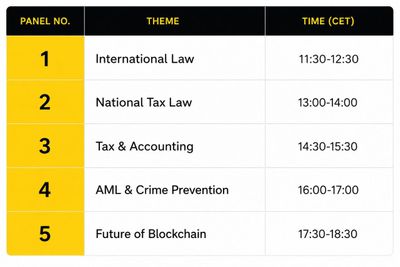
Sessions are constructed around problems practitioners are currently encountering rather than around introductions to blockchain technology. The programme provides substantive treatment of:
- Cryptocurrency taxation across income, capital gains, and wealth tax regimes
- Decentralised finance, and the identification of the taxable person
- Stablecoins and central bank digital currencies
- NFTs, including questions of valuation and characterisation
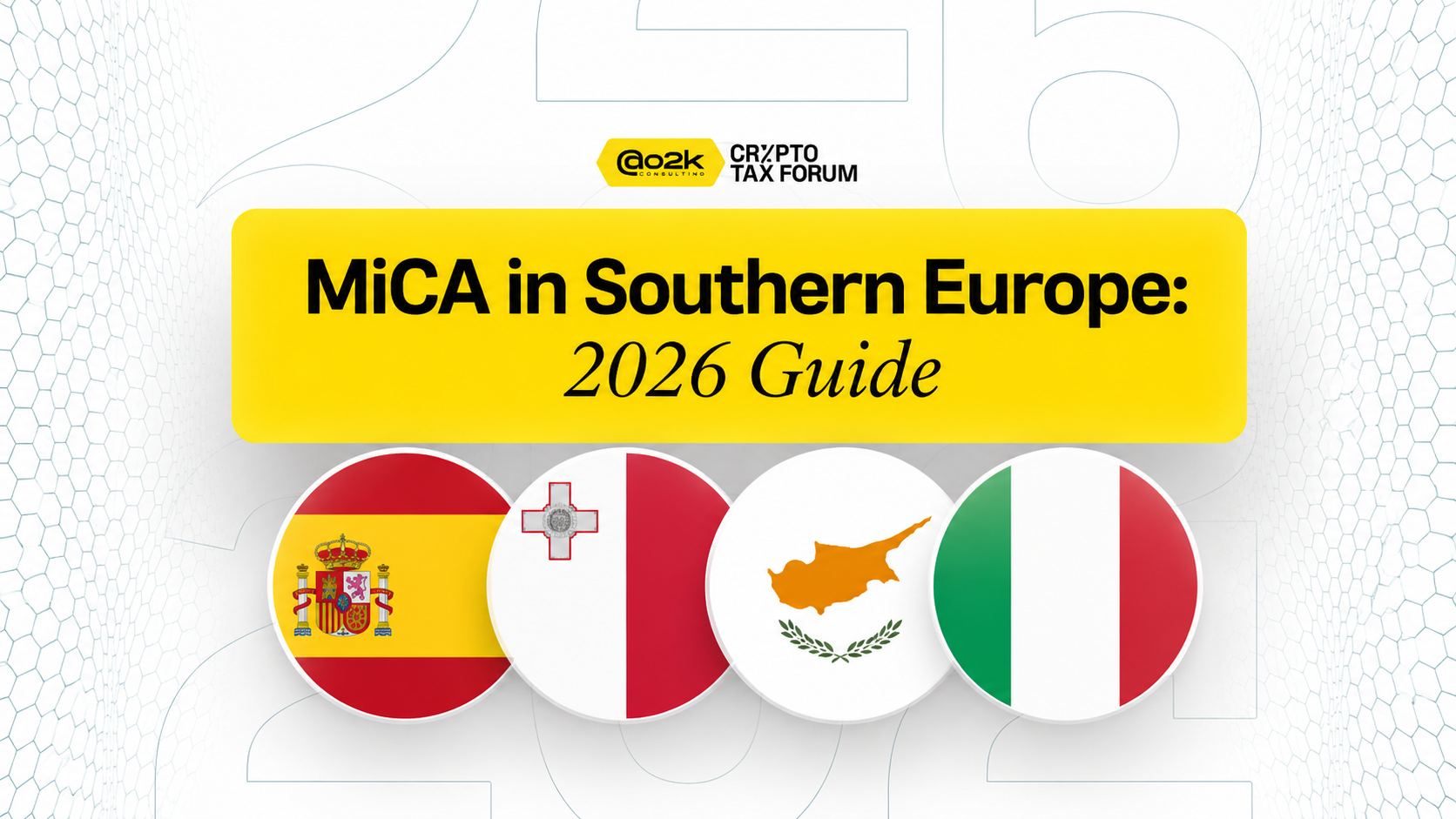
- MiCA authorisation, supervision, and divergence in national practice after the July 2026 transition
- The OECD Crypto-Asset Reporting Framework and DAC8 in practice
- Tax reporting, record-keeping, and the evidential standards authorities apply
- Anti-money laundering obligations and financial crime enforcement
- Cross-border structuring and the associated risks
- Audits, disputes, and litigation involving digital assets
Who Attends
The audience is deliberately mixed. Stakeholders from the crypto industry meet stakeholders from the tax and regulatory world, and the value of the conference derives from that combination rather than from either constituency addressing itself.

Participants include tax advisers, accountants, auditors, lawyers, compliance and financial crime professionals, officials from revenue agencies and finance ministries, policymakers, law enforcement and prosecution services, crypto exchanges and custodians, Web3 founders and their finance teams, banks and payment institutions, academics and researchers, students, and investors seeking to understand their own reporting obligations.
The programme is designed for those who advise on digital assets, build products that involve them, or draft and enforce the rules that govern them.
The Forum Beyond the Conference
The conference is the most visible element of the Forum, but the community operates throughout the year. Members receive regulatory updates, jurisdiction-by-jurisdiction analysis, practical commentary on developments as they occur, and access to educational material and courses.
Join the Crypto Tax Forum WhatsApp Community
The conversation does not stop when the conference ends. The Crypto Tax Forum has a general WhatsApp community that anyone can join, providing a space for professionals, researchers, businesses, and anyone interested in crypto taxation and regulation to stay connected throughout the year.
Join the community to follow the latest discussions, share insights, exchange perspectives, and stay up to date with developments across the global crypto tax landscape.
The Forum also represents its members externally. In September 2025, Crypto Tax Forum presented at INTERPOL’s New Technologies Forum, convening tax and law enforcement professionals from the Netherlands, Belgium, Luxembourg, Poland, Hungary, Gibraltar, and the Americas to examine how crypto assets, stablecoins, and DeFi protocols are used in cross-border tax evasion, and what constitutes an effective investigative response. Work of this kind is made possible by the community and feeds directly into the conference programme.
The Crypto Tax Forum Book
A further project currently in development is the Crypto Tax Forum Book, which will consolidate the material from previous editions into a single reference work.
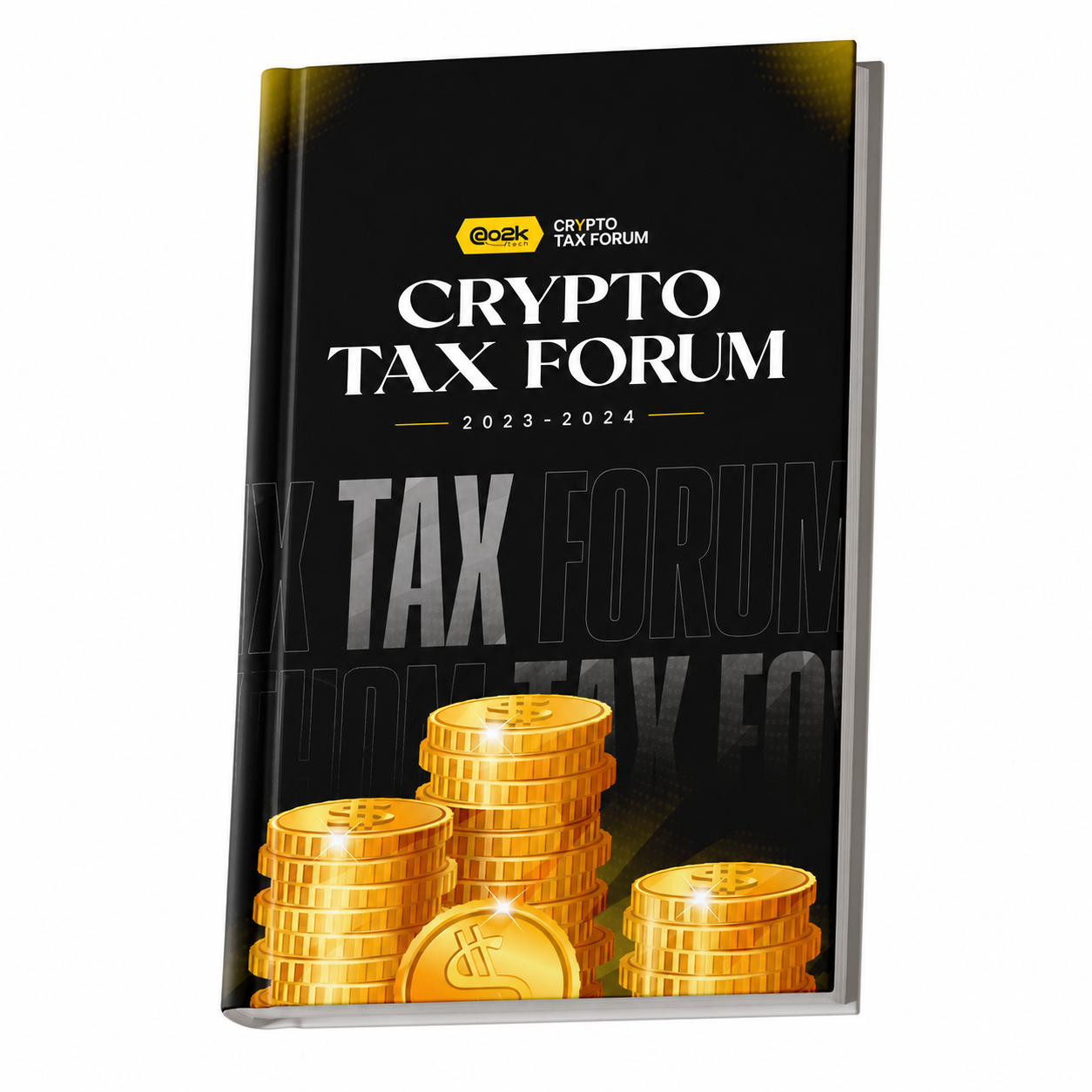
Conference recordings serve a purpose, but they are difficult to cite, hard to search, and impractical to pass to a colleague. The book is intended to address expert analysis, panel conclusions, and jurisdictional detail organised so that a practitioner can locate the answer to a specific question without reviewing several hours of video. It is written for tax and legal professionals, policymakers, in-house compliance teams, researchers, and others requiring a durable account of how crypto taxation has developed and the direction in which it is moving.
The book will be published on Amazon and available to order directly, without an institutional subscription or library request standing between the reader and the material. This is a deliberate choice. A considerable proportion of the most rigorous writing on crypto taxation currently sits behind professional subscriptions, which limits its circulation precisely where wider access would raise the general standard of practice.
The publication date and listing will be announced once confirmed.
Membership
Applications are open for membership of the Crypto Tax Forum community.
Membership provides access to an international network of professionals addressing the same questions, to educational initiatives and regulatory updates as they are issued, and to the opportunity to contribute to the discussions shaping crypto tax policy rather than only to observe their outcome. Members are drawn from private practice, from industry, and from government, and that distribution is intentional.
Membership is not restricted by seniority. Contributions from those recently entering the field have consistently proved as valuable as those from established practitioners.
Want to be a member? Apply here.
Crypto Tax Forum 2026: Practical Details

The programme combines keynote addresses, panel discussions between industry and regulators, individual technical presentations, and structured networking.
Detailed session times and the full speaker list are now available on our website.
- Date: 9 September 2026
- Format: Online, via Zoom
- Accreditation: 10 CPE points and Certificate of Attendance
The programme combines keynote addresses, panel discussions between industry and regulators, individual technical presentations, and structured networking. Detailed session times and the full speaker list are available on our website.
Looking Ahead
Crypto assets have changed how a great many people hold value and move it. Whether that change produces durable financial infrastructure or a sector that periodically fails under its own opacity will be determined largely by how taxation and regulation develop over the next several years. The question is not settled.
The outcome will be better if those writing the rules and those operating under them engage directly and regularly. That premise has guided the Crypto Tax Forum since 2023 and continues to guide its work.
We look forward to welcoming you on 9 September.
For sponsorship enquiries send an email to cryptotaxforum@o2k.tech
.svg)


.jpg)
.png)


.jpg)

.jpg)

.jpg)

.png)
.jpg)
.jpg)

.jpg)

.jpg)
.png)
.jpg)
.JPEG)
%20(1).jpg)
.png)


.jpg)

.jpg)
.jpg)

.png)

.png)





.png)











.jpeg)






.jpg)