
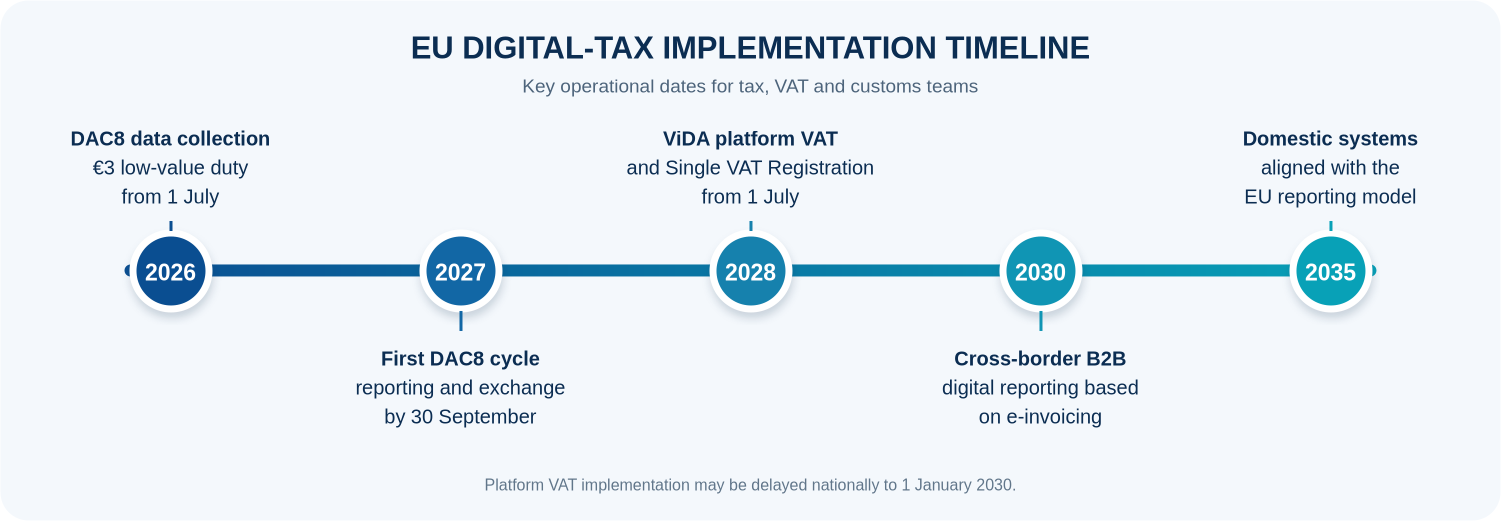
- DAC8 applies from 1 January 2026. Reporting Crypto-Asset Service Providers (RCASP) must collect data on reportable transactions during 2026, with the first reporting and exchanges due in 2027.
- ViDA is now in its implementation phase. EU cross-border B2B digital reporting begins in 2030, while national e-invoicing changes and earlier reforms make 2026 an important preparation year.
- Digital platforms already report seller information under DAC7, and ViDA will expand VAT responsibility for certain accommodation and road-passenger-transport platforms.
- From 1 July 2026, a temporary EUR 3 customs duty applies per item to low-value consignments up to EUR 150. Product identifiers become mandatory from 1 November 2026.
For several years, the European debate on the digitalising economy concentrated on where the profits of large technology companies should be taxed. Questions around digital services taxes, nexus and the OECD's Pillar One project remain relevant.
In 2026, however, the most concrete changes affecting day-to-day business concern the information that companies must collect, structure and transmit to public authorities.
The EU's digital tax landscape now operates at two connected levels:
- The first concerns how income and transactions generated through digital business models are taxed.
- The second concerns the digitalisation of tax administration itself: e-invoicing, platform reporting, crypto-asset transaction data and customs information that can be exchanged and analysed electronically.
Taken together, DAC8, DAC7, the VAT in the Digital Age package and the 2026 customs changes are building a much more visible transaction environment. Companies therefore need to separate the rules already applying from later deadlines while preparing their systems early enough to meet both.

The First Crypto-Reporting Data Year For DAC8
DAC8 applies from 1 January 2026 and extends the EU's automatic exchange-of-information framework to crypto-assets. It leaves substantive tax rates and the classification of income or gains to national law, while creating a common reporting layer.
RCASPs must collect and verify information on EU-resident users and report data on relevant crypto-asset transactions to the competent tax authority.
The regime covers domestic and cross-border activity and a broad range of assets, including decentralised crypto-assets, stablecoins and certain non-fungible tokens.
The first reporting year is 2026 therefore information must be reported in the following calendar year, and the first exchanges between EU tax authorities must take place by 30 September 2027. The European Commission also highlights a single-registration route for operators active in the EU that are not authorised under MiCA. For businesses, this means that 2026 is already a live data year: gaps discovered in 2027 may relate to transactions that should have been captured correctly from the start of 2026.
Operationally, the challenge lies in tax residence, taxpayer-identification data, asset classification, transaction values and reconciliation across wallets and platforms. A customer record that is adequate for commercial onboarding may still be insufficient for tax reporting.
RCASPs should test whether source systems can produce complete and consistent data, while companies that use crypto service providers should review whether their own books and supporting records can be reconciled with information likely to be reported by third parties. @O2K's separate DAC8 and CARF overview provides further background on the reporting architecture.
ViDA: What the New EU VAT Rules Mean for Businesses
The ViDA package entered into force on 14 April 2025 and is being implemented progressively through 2035.
Its three pillars are:
- Digital reporting based on e-invoicing
- Updated VAT rules for the platform economy
- Wider Single VAT Registration framework.
The Commission's 2026 implementation work programme confirms that the technical and legal preparation is now under way, even though the main EU-wide cross-border reporting deadline falls later.
Member States may already introduce mandatory domestic e-invoicing under the conditions established by ViDA. Certain OSS and IOSS clarifications apply from 1 January 2027. From 1 July 2028, Single VAT Registration measures and deemed-supplier rules for short-term accommodation and road passenger transport platforms begin to apply, although Member States may delay the platform measure until 1 January 2030. Cross-border B2B Digital Reporting Requirements based on e-invoicing begin on 1 July 2030, and existing domestic real-time reporting systems must align with the EU model by 1 January 2035.
For companies, the practical conclusion is straightforward. Invoice data, customer and supplier master data, VAT logic and ERP workflows need to be designed as a connected system. National e-invoicing mandates may affect a business well before 2030, and a group operating across several Member States may face different transitional requirements.
A readiness review should therefore examine data fields, validation rules, invoice timing, correction processes, archiving and the ability to transmit information in the required structured format.
How Platforms Are Joining the Tax Collection Infrastructure
DAC7 has applied since 2023 and already places due-diligence and annual reporting obligations on digital platform operators. The rules cover the rental of immovable property, personal services, the sale of goods and the rental of transport.
They can apply to EU operators and to non-EU operators facilitating relevant activities for EU-resident sellers. Reported information includes seller-identification data and financial information such as the consideration paid or credited. DAC7 itself does not impose a new tax on sellers; national law determines the underlying income-tax and VAT treatment.
ViDA continues this policy direction through a deemed-supplier model for specified accommodation and road passenger transport services. Where the underlying provider does not account for VAT, the facilitating platform may have to collect and remit it. The scope is sector-specific, so companies should avoid treating every marketplace, payment interface or software provider in the same way. The analysis should follow the actual contractual role, control over the transaction, flow of payment and information available to the platform.
The wider policy logic is clear: platforms often hold better transaction data than the individual sellers using them. This makes them effective points for reporting and collection.
For a platform business, tax classification can therefore affect onboarding questions, seller verification, contract wording, payout processes, invoicing, pricing and record retention. Tax obligations increasingly shape product design rather than remaining a task performed only after the transaction has closed.
What Temu and SHEIN Show About Low-Value E-Commerce

A 2026 European Parliament briefing identifies Temu and SHEIN as prominent examples of platforms that expanded through low-cost goods shipped directly to consumers in small parcels. It records the Commission's estimate that approximately 4.6 billion low-value parcels entered the EU in 2024, with more than 90% arriving from China. The Commission later reported almost 5.9 billion low-value items in 2025. This scale places substantial pressure on customs systems that were designed for a very different pattern of trade.
From 1 July 2026, the EU replaced the customs-duty relief for consignments up to EUR 150 with a temporary EUR 3 customs duty per item. The amount is calculated by tariff-classification item rather than by parcel and is scheduled to apply until 1 July 2028.
The declarant - generally the seller, importer, IOSS holder, special-arrangements user or an indirect representative - is responsible for the duty in most cases. Product identifiers may be supplied voluntarily from July and become mandatory on 1 November 2026 to strengthen traceability and safety checks.
Temu and SHEIN should be understood here as cautionary examples of the regulatory exposure created by very high-volume, low-value e-commerce. They have also faced separate EU action under digital-services and consumer-protection law: the Commission fined Temu under the Digital Services Act in May 2026 and opened formal DSA proceedings against SHEIN in February 2026. Those proceedings concern separate legal regimes and do not establish tax evasion or customs fraud. Their relevance to this article lies in the EU's broader move towards holding large platforms accountable for the transactions and products passing through their systems.
Businesses using similar direct-to-consumer models should review who acts as declarant, how IOSS and import VAT are managed, whether goods are classified and valued correctly, and how origin and product identifiers are stored. They should also test whether the EUR 3 duty is reflected accurately in pricing, refunds and customer communications.
A model built around a very large number of small consignments now carries a more visible customs cost and a greater need for reliable item-level data.
What Companies Should Do in 2026
The first step is to identify the role the business performs in each transaction. The relevant role may be RCASP, platform operator, seller, deemed supplier, IOSS intermediary, importer or customs declarant, and the same group can hold several roles across different business lines.
A legal-entity and transaction-flow map should show which rules apply, which Member State receives the report, and which party is contractually responsible for collecting the underlying data.
The second step is a tax-data gap assessment. Companies should review:
- Tax residence and taxpayer-identification fields
- Transaction IDs, timestamps and exchange-rate methods
- VAT invoice data
- Seller due-diligence records
- Product identifiers
- Tariff classification and origin information
The purpose is to determine whether source systems can reproduce the figures submitted to tax or customs authorities and explain any difference between operational data, accounting records and regulatory reports. Reconciliation and exception-handling controls should be tested with real transactions rather than policy documents alone.
Finally, responsibility should be shared across tax, finance, IT, legal, compliance and logistics teams. Companies should assign clear data owners, establish retention and change-control rules, monitor national implementation, and train staff before a reporting cycle begins.
The technology does not need to solve every future requirement at once, but it should be adaptable enough to accommodate new fields, national formats and validation rules without rebuilding the entire reporting process.
Conclusion
Crypto transactions are entering automatic tax reporting, VAT compliance is moving towards structured e-invoicing, platforms are taking on wider reporting and collection functions, and low-value e-commerce is subject to closer customs control. The deadlines are staggered, but the operating model is converging around better data, clearer responsibility and faster exchange between businesses and authorities.
Companies should therefore keep digital taxation under active review and ensure that the people managing transactions understand how the rules interact.
O2K's courses and training are designed to help tax, legal, finance and compliance professionals build that understanding.
Early awareness gives businesses more time to adapt systems, contracts and internal controls before a reporting deadline turns a technical gap into a compliance problem.
.svg)


.jpg)
.png)




.jpg)

.jpg)

.png)
.jpg)
.jpg)

.jpg)

.jpg)
.png)
.jpg)
.JPEG)
%20(1).jpg)

.png)



.jpg)

.jpg)
.jpg)

.png)

.png)








.png)













.jpeg)








.jpg)